
The SDM Clinic Model
Good shared decision-making deserves a clear, structured approach.

Good Shared Decision Making
Research shows that patients often recall less than half of the risks discussed during consent conversations - in emergency surgery specifically, recall has been measured as low as 50.6%.¹˒² Decisional regret can follow when patients do not feel genuinely involved in decision-making, or do not fully understand the options and risks discussed.³˒⁴
This isn't a communication failure alone. It's often a structural one – decisions made without a clear framework for assessment, for genuinely aligning with what the patient wants, or for planning what happens next, regardless of what's decided.
Why this matters
A structured clinical model
MAP is for clinicians working through complex decision making
MAP – Medical Assessment, Align Decisions, Plan & Support – is a structured clinical model for medical assessment, shared decision-making, and care planning, built for clinicians working through complex decisions with patients across oncology, surgery, medicines, investigations, chronic disease management, mental health care, rehabilitation, and aged care.
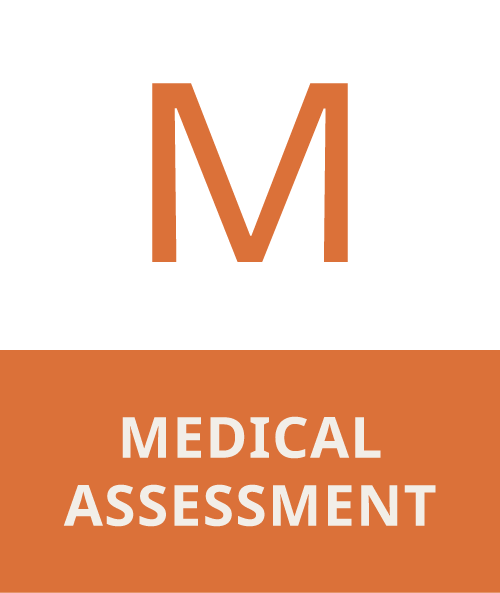
M – Medical Assessment
Comprehensive clinical assessment, covering medical conditions, and health, function, frailty and cognition, where relevant.
Medical Assessment isn't a new idea. Geriatricians have long practised this through Comprehensive Geriatric Assessment (CGA) – a structured, multidimensional review of a person's medical, functional, cognitive and social status, shown to improve outcomes for older adults, including increased likelihood of living independently at home after hospital admission.⁵˒⁶˒⁷
MAP takes this same thinking and applies it more broadly. Frailty and cognition are assessed where relevant, not by default - a younger patient with significant comorbidities may benefit from the same careful assessment as an older patient, while for others these domains may not be relevant at all.
This is the foundation everything else in MAP is built on.
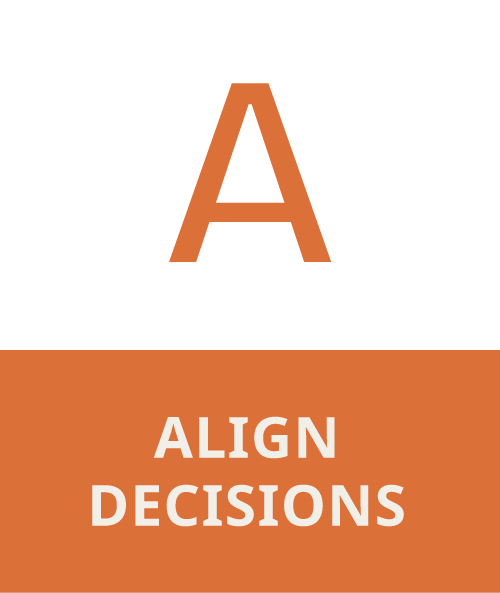
A – Align Decisions (ALL-BRAN)
Shared decision-making, understanding what matters most to the person, and aligning healthcare decisions with their goals, values and preferences.
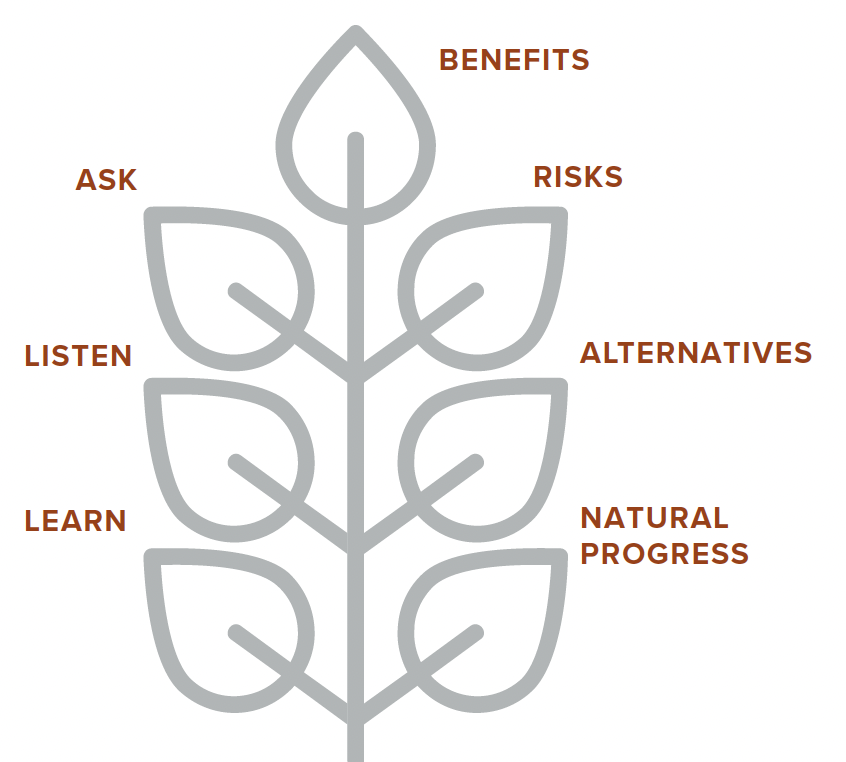
Once assessment is complete, the next step is aligning the decision with the patient in front of you, not just their diagnosis. Within Align Decisions, the SDM conversation is guided by ALL BRAN, our structured conversation guide. ALL – Ask, Listen, Learn – ensures the patient's goals, values and priorities are understood before any options are discussed. BRAN – Benefits, Risks, Alternatives, Nothing – ensures the clinical discussion itself is complete, covering not just the proposed treatment, but genuine alternatives and the option of no treatment at all.
This is also where Realistic Medicine³˒⁸ matters most. Realistic Medicine means care that genuinely fits the person in front of you, not a one-size-fits-all approach applied regardless of their circumstances. Clinicians bring genuine expertise in their own medical or surgical field, and shared decision-making includes the confidence to use that expertise to guide, not only to inform. For a patient with multimorbidity or frailty, the same treatment plan that suits one person may carry very different risks and benefits for another with the same diagnosis. Once you've properly understood the patient through Medical Assessment and ALL, you're well placed to be clear about what genuinely fits them - and comfortable saying so, as part of the shared decision.
Psychological safety
Patients feeling able to voice concerns, uncertainty, or disagreement without fear of judgement - is what makes this conversation genuine rather than procedural.⁹
Communicating across language and health literacy
Not every patient starts this conversation from the same place. Language, health literacy, and cultural background all shape how clearly information lands - and for migrant populations in particular, this is often where shared decision-making genuinely breaks down, not in the clinical complexity itself.¹⁰
Plain language, professional interpreters where needed, and translated resources are what make ALL BRAN genuinely accessible, not just technically offered.
Metaphor and analogy are a legitimate clinical communication tool, shown to support patient understanding and shared decision-making.¹¹ The road-trip analogy used throughout this platform - the car as the body, the mechanic's check as pre-admission assessment, prehab as preparing for the journey - was developed for use in clinic and has been useful in practice, though not yet formally evaluated.
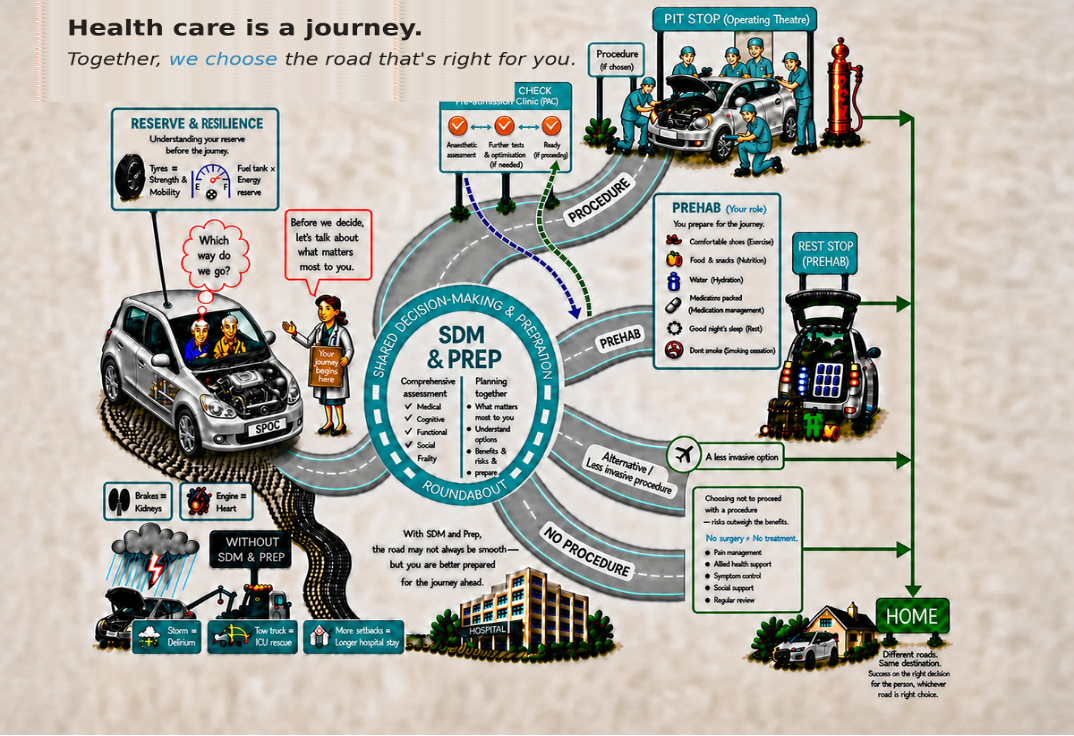
Equity is achieved when information is understandable, not simply available.
The full picture of risk
Patients aren't just consenting to a risk when they understand it - they're consenting to uncertainty when they don't.
A common gap is talking about risk as if it belongs only to the treatment, procedure, or intervention itself. In practice, a great deal of risk sits elsewhere:
After surgery, many of the most significant risks are medical, not surgical. Delirium is a clear example, particularly in frail or cognitively impaired older patients, where the risk often has little to do with the operation itself and everything to do with the person's baseline vulnerability.¹⁰ Falls are another well-recognised risk during hospital admission and periods of deconditioning, not the procedure performed.
In oncology, broader risks worth keeping in view alongside treatment-specific toxicity include infection risk during immunosuppression, and the effect frailty can have on a patient's ability to tolerate a full treatment course.
This is precisely why our clinician form splits Risks into three groups, not one - Medical, Anaesthetic, and Procedure-specific - rather than a single list centred on the intervention alone. Patients deserve the full picture, not just the part of it that's easiest to name.
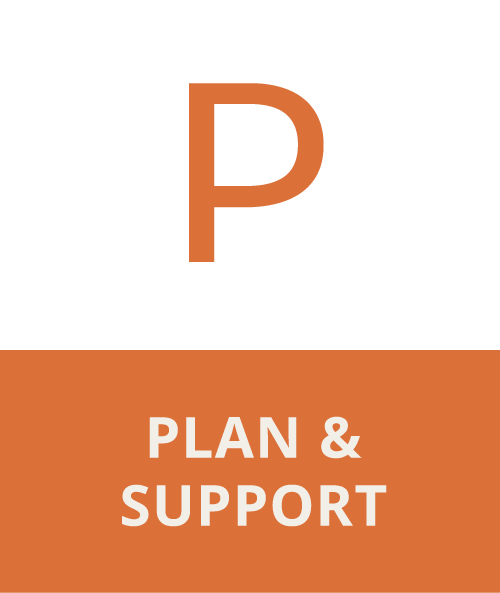
P – Plan & Support
Individualised care plan, optimising health and wellbeing, advance care planning, multidisciplinary coordination, and an agreed treatment, alternative, or supportive care plan.
A decision is not the end of the process. Whatever is decided - proceeding, choosing an alternative, or choosing supportive care instead - active planning continues.
Plan & Support includes:
An individualised care plan, built from the assessment and the aligned decision
Optimising health and wellbeing, including prehabilitation where relevant, particularly for frail or multimorbid patients facing a procedure
Advance care planning, where appropriate
Multidisciplinary coordination, ensuring the plan is followed through, not just documented
An agreed plan does not mean the patient's care stops here, whichever path is chosen - treatment, an alternative, or supportive care continues to be actively planned and coordinated.
Confirm understanding – teach-back
Patient understanding
Before the consultation ends, ask the patient to explain the whole discussion back in their own words - the decision reached, and the plan that follows it. This isn't a test of the patient — it's a check on whether the conversation has actually landed, not just been delivered.¹¹
For the clinician
Does the patient's explanation match the decision and the agreed plan?
For the patient
In your own words, what have we decided today, and what happens next?
If something hasn't fully landed, that's useful information - it may point to a need for an interpreter, more health-literate resources, or simply a different way of explaining what's already been said.
Practice
Putting MAP into practice
The clinician form currently supports two parts of MAP directly: Align Decisions, through ALL BRAN, and Plan & Support, through its planning, referral and follow-up sections. Medical Assessment isn't yet a dedicated part of the form - for now, this step is carried out through your own clinical assessment, alongside the brief background captured at the start of the form.
ALL BRAN, used within Align Decisions, is how this thinking gets put into practice at the point of care - a structured, practical way to have the conversation MAP calls for, without needing to hold the whole framework in your head during a busy clinic.
A note on how to use this tool
This form is designed to support the conversation, not replace it. It does not replace your own clinical assessment and judgement - assessing your patient still comes first.
Its value is partly in documentation, giving a clear, structured record of what was discussed. But its greater value is in what it gives the patient: a chance to reflect on the conversation afterward, together with their family or carers, and to raise anything further before a decision is finalised.
Before using the form for the first time, take a moment to read through how it works. It's built around the same MAP structure explained on this page, and understanding it will help you use it well.
-
D'Souza RS, Johnson RL, Bettini L, Schulte PJ, Burkle C. Room for improvement: a systematic review and meta-analysis on the informed consent process for emergency surgery. Mayo Clin Proc. 2019;94(9):1786-1798.
Aasen DM, Wiesen BM, Singh AB, Piper C, Harnke B, Prochazka AV, Fink AS, Hammermeister KE, Meguid RA. Systematic review of preoperative risk discussion in practice. J Surg Educ. 2020;77(4):911-920.
Scottish Government. Shared decision making in realistic medicine: what works. Edinburgh: Scottish Government; 2019.
Sherlock A, Brownie S. Patients' recollection and understanding of informed consent: a literature review. ANZ J Surg. 2014;84(4):207-210.
Ellis G, Whitehead MA, Robinson D, O'Neill D, Langhorne P. Comprehensive geriatric assessment for older adults admitted to hospital: meta-analysis of randomised controlled trials. BMJ. 2011;343:d6553.
Ellis G, Gardner M, Tsiachristas A, Langhorne P, Burke O, Harwood RH, et al. Comprehensive geriatric assessment for older adults admitted to hospital. Cochrane Database Syst Rev. 2017;9(9):CD006211.
Veronese N, Custodero C, Demurtas J, Smith L, Barbagallo M, Maggi S, et al. Comprehensive geriatric assessment in older people: an umbrella review of health outcomes. Age Ageing. 2022;51(5):afac104.
Realistic Medicine Scotland. About Realistic Medicine. NHS Scotland.
Fukami T. Shared decision making with psychological safety. Lancet. 2023;401(10383):1153-1154.
Dobler CC, Spencer-Bonilla G, Gionfriddo MR, Brito JP. Shared decision making in immigrant patients. Cureus. 2017;9(7):e1461.
Liu X. Use of metaphor in provider-patient communication in medical settings: a systematic review. Patient Educ Couns. 2025;137:109184.
American Geriatrics Society Expert Panel on Postoperative Delirium in Older Adults. American Geriatrics Society abstracted clinical practice guideline for postoperative delirium in older adults. J Am Geriatr Soc. 2015;63(1):142-150.
Talevski J, Wong Shee A, Rasmussen B, Kemp G, Beauchamp A. Teach-back: a systematic review of implementation and impacts. PLOS ONE. 2020;15(4):e0231350.

Contact Us
Want to implement SDM in your service?
Get in touch with the SDM Navigator team at Blacktown Hospital.